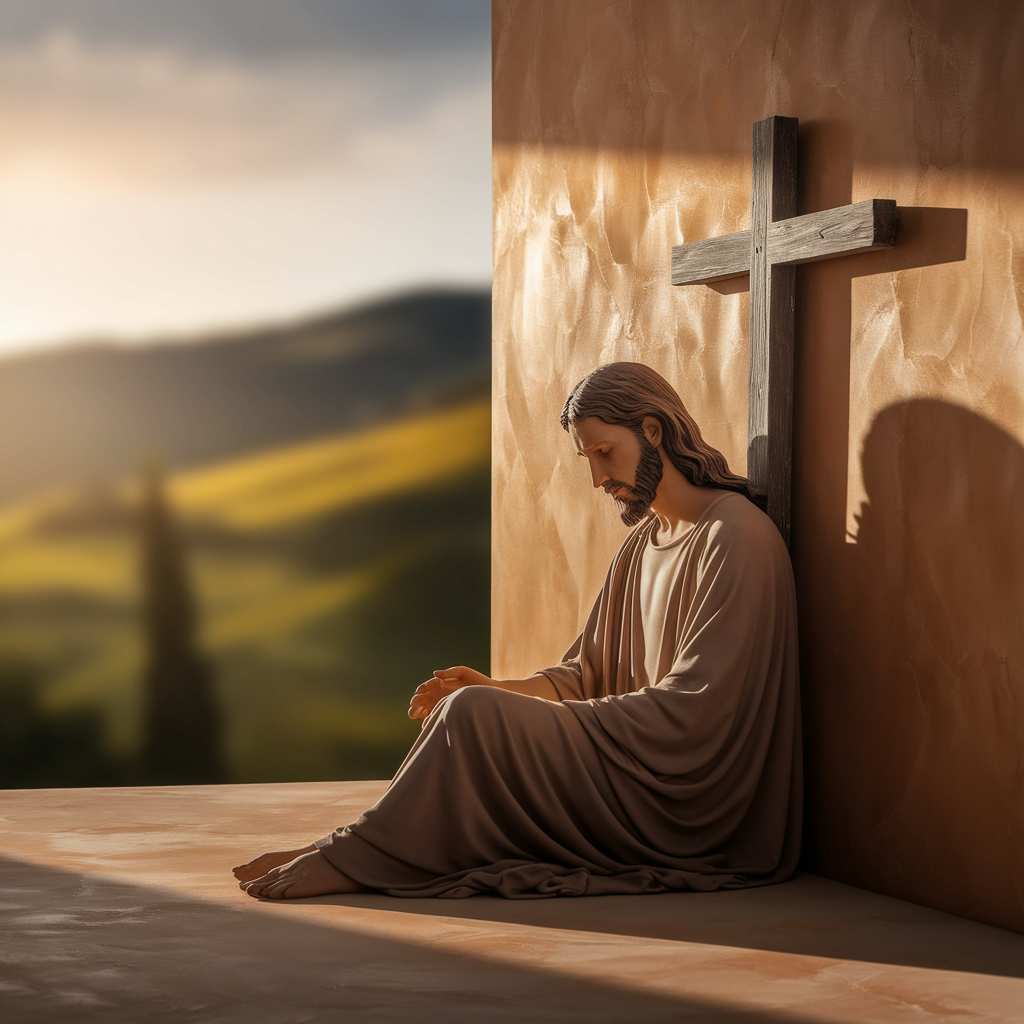
Who is Jesus Christ? It is the most important question any person can answer. Jesus Himself asked His disciples, “Who do you say I am?” (Matthew 16:15), and the way we answer shapes our identity, our purpose, and our eternity. This guide walks through what the Gospels reveal about the life, ministry, death, and resurrection of Jesus of Nazareth, so that you can meet Him for yourself in Scripture.

The Birth and Early Life of Jesus
The story of Jesus begins long before Bethlehem. John’s Gospel opens by describing Him as the eternal Word: “The Word became flesh and made his dwelling among us” (John 1:14). Christians have always understood this to mean that God Himself entered human history in the person of Jesus.
Jesus was born in Bethlehem of Judea to Mary, a young woman who was a virgin, in fulfilment of Isaiah 7:14. Luke 2:1-7 tells us that Joseph and Mary had travelled there for a census, and that the child was laid in a manger because there was no guest room available. The place of His birth had been foretold centuries earlier by the prophet Micah (Micah 5:2), and shepherds, the humblest of witnesses, were the first to hear the good news (Luke 2:8-20). Matthew adds that wise men from the east came to worship Him (Matthew 2:1-12).
After a brief flight to Egypt to escape King Herod, the family settled in Nazareth, a small town in Galilee (Matthew 2:13-23). The Gospels say very little about His childhood, but Luke gives us one glimpse: at twelve years old, Jesus was found in the temple listening to the teachers and asking questions, and afterwards “Jesus grew in wisdom and stature, and in favor with God and man” (Luke 2:52). He was fully human, learning and growing as any child does.
The Baptism and Temptation of Jesus
At about thirty years of age, Jesus came to the Jordan River to be baptized by John the Baptist. As He came up out of the water, the Spirit of God descended on Him like a dove, and a voice from heaven declared, “This is my Son, whom I love; with him I am well pleased” (Matthew 3:17). It was a public affirmation of who Jesus is, and it marked the start of His ministry.
Immediately afterwards the Spirit led Jesus into the wilderness, where He fasted for forty days and was tempted by the devil (Matthew 4:1-11). Each time, Jesus answered with Scripture. When tempted to turn stones into bread, He replied, “Man shall not live on bread alone, but on every word that comes from the mouth of God” (Matthew 4:4). The writer of Hebrews reminds us why this matters to us: Jesus was “tempted in every way, just as we are—yet he did not sin” (Hebrews 4:15). We have a Savior who understands our struggles from the inside.
The Ministry of Jesus: Teaching, Miracles, and Compassion
Jesus began to preach with a simple message: “The time has come… The kingdom of God has come near. Repent and believe the good news!” (Mark 1:15). He called ordinary men and women to follow Him, including fishermen, a tax collector, and many who were considered outsiders. He chose twelve to be His closest disciples and trained them to carry on His work.
His teaching was unlike anything the crowds had heard. In the Sermon on the Mount (Matthew 5-7) He spoke about the heart behind the law, about loving our enemies, about prayer, and about trusting the Father for daily needs. If you would like to go deeper, read our study on the Sermon on the Mount and why it still matters. He also taught in parables, simple stories that revealed the nature of God’s kingdom, which you can explore in our guide to the famous parables of Jesus.
Alongside His words came works of power and mercy. At a wedding in Cana, He turned water into wine (John 2:1-11). He calmed a storm with a word, leaving the disciples asking, “Who is this? Even the wind and the waves obey him!” (Mark 4:35-41). He fed more than five thousand people with five loaves and two fish (John 6:1-14), healed the sick, gave sight to the blind, and raised Lazarus from the dead (John 11). These signs were not spectacle for its own sake. John tells us they were recorded so that we might believe (John 20:31).
Throughout His ministry Jesus showed particular tenderness toward the poor, the sick, the grieving, and the sinner. He touched lepers, welcomed children, and ate with those whom respectable society avoided. He summed up His own mission this way: “For even the Son of Man did not come to be served, but to serve, and to give his life as a ransom for many” (Mark 10:45).
What Jesus Said About Himself
Jesus was more than a gifted teacher. In the Gospel of John He made a series of “I am” statements that point to His identity: “I am the bread of life” (John 6:35), “I am the light of the world” (John 8:12), “I am the good shepherd” (John 10:11), “I am the resurrection and the life” (John 11:25), and “I am the way and the truth and the life. No one comes to the Father except through me” (John 14:6). He also said, “I and the Father are one” (John 10:30).
The apostle Paul echoed this conviction when he wrote that Jesus “is the image of the invisible God, the firstborn over all creation” (Colossians 1:15). In the early church’s hymn recorded in Philippians 2:5-11, Jesus is the One who, though in very nature God, humbled Himself to the point of death on a cross, and whom God has now exalted. For a fuller look at His teachings and character, see Who Is Jesus Christ? His Life, Teachings, and Why He Still Matters.
The Death of Jesus on the Cross
As His ministry drew to a close, Jesus set His face toward Jerusalem, knowing what awaited Him. After sharing a final meal with His disciples, He prayed in the garden of Gethsemane, was betrayed by Judas, arrested, and put on trial. He was handed over to Pontius Pilate and sentenced to crucifixion (Mark 14-15).
On the cross, even in agony, Jesus prayed for those who crucified Him: “Father, forgive them, for they do not know what they are doing” (Luke 23:34). Shortly before He died, He cried, “It is finished” (John 19:30). The prophet Isaiah had described the meaning of this moment centuries earlier: “But he was pierced for our transgressions, he was crushed for our iniquities; the punishment that brought us peace was on him, and by his wounds we are healed” (Isaiah 53:5).
Christians believe the cross is where God’s justice and love met. Jesus bore the penalty for sin so that we could be forgiven and reconciled to God. “For God so loved the world that he gave his one and only Son, that whoever believes in him shall not perish but have eternal life” (John 3:16). If you are asking what it means to receive that gift, you may find help in What Does It Mean to Be Saved?
The Resurrection of Jesus Christ
Jesus was taken down from the cross and laid in a tomb that was sealed and guarded. But on the first day of the week, women who came to anoint His body found the stone rolled away. An angel told them, “He is not here; he has risen, just as he said” (Matthew 28:6). Over the following days and weeks, Jesus appeared to Mary Magdalene, to the disciples gathered behind locked doors, to two travellers on the road to Emmaus, and to Thomas, who had doubted (Luke 24; John 20).
Paul, writing within a few decades of the event, lists the witnesses: Jesus appeared to Peter, to the Twelve, and then “to more than five hundred of the brothers and sisters at the same time, most of whom are still living” (1 Corinthians 15:6). He is clear about what is at stake: “And if Christ has not been raised, your faith is futile; you are still in your sins” (1 Corinthians 15:17). The resurrection is the cornerstone of the Christian faith.
After forty days, Jesus ascended to heaven, promising to return (Acts 1:9-11). Before leaving, He gave His followers a mission and a promise: “And surely I am with you always, to the very end of the age” (Matthew 28:20). To examine the evidence in more depth, read The Resurrection of Jesus: The Evidence and What It Means for You.
Why Jesus Christ Still Matters Today
Knowing who Jesus is is not only a matter of history. The New Testament says that He lives and invites every person into a relationship with Him. Paul put it plainly: “If you declare with your mouth, ‘Jesus is Lord,’ and believe in your heart that God raised him from the dead, you will be saved” (Romans 10:9).
That relationship touches every part of life. Because of Jesus, we can approach God with confidence, receive forgiveness instead of condemnation, find strength in weakness, and live with hope that death does not have the last word. If you would like a practical place to begin, the Gospel of John is an excellent starting point, and our Gospel of John Bible study guide will walk you through it chapter by chapter.
Quick Faith Quiz
In which town was Jesus born, fulfilling Old Testament prophecy?
- A. Nazareth
- B. Jerusalem
- C. Bethlehem
- D. Capernaum
Reveal the answer
C — Bethlehem, as prophesied in Micah 5:2.
Reflection Questions
- Who do you say Jesus is: a teacher, a prophet, or Lord and Savior?
- How has knowing Jesus personally changed the way you face fear, failure, or loss?
- Which part of Jesus’ life or ministry most challenges or inspires you, and why?
- What is one step you can take this week to know Him better, such as reading one chapter of a Gospel each day?
Frequently Asked Questions About Jesus Christ
Who is Jesus Christ in simple terms?
Christians believe Jesus Christ is the Son of God who became human, lived a sinless life, died on the cross for the sins of the world, and rose again on the third day. He is both the promised Messiah and the Savior who offers forgiveness and eternal life to all who trust in Him (John 3:16; Romans 10:9).
Was Jesus a real historical person?
Yes. Jesus of Nazareth is attested in the four Gospels and in the letters of the New Testament, and He is also mentioned by ancient non-Christian writers such as the Roman historian Tacitus and the Jewish historian Josephus. Historians widely agree that He lived in first-century Judea and was crucified under Pontius Pilate.
Why did Jesus have to die?
According to Scripture, Jesus died to take the penalty for human sin so that we could be forgiven and restored to God. He said He came “to give his life as a ransom for many” (Mark 10:45), and Paul writes that “Christ died for our sins according to the Scriptures” (1 Corinthians 15:3).
How can I know Jesus personally?
The Bible invites you to turn from sin, trust in Jesus as Lord and Savior, and pray honestly to Him (Romans 10:9-10). Begin reading the Gospels, talk to God in prayer, and connect with a Bible-believing church where you can grow alongside other believers.
Lord Jesus, thank You for coming to earth, living among us, dying for us, and rising again. Help us to know You more deeply every day, to trust You with our whole lives, and to follow You wherever You lead. Amen.